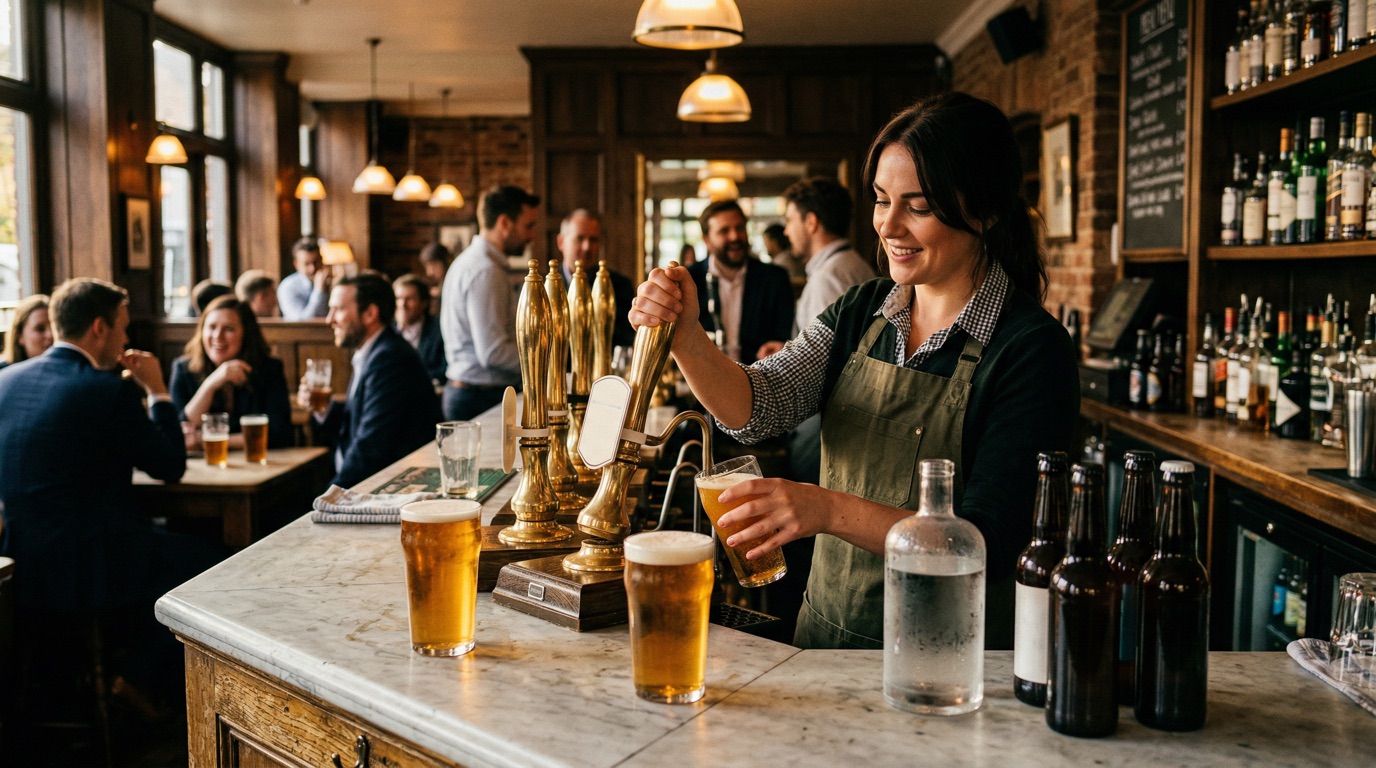
For decades, the non-drinker's pub experience was grim. Ask what alcohol-free options they had and you'd get a shrug, a dusty bottle of Kaliber from the back of the fridge, or the immortal suggestion: lime and soda.
That's changed. Dramatically, statistically, and visibly. But 'better than terrible' and 'actually good' are different things. Here's where UK pubs really stand on AF drinks in 2025, and what that means if you're trying to have a decent night out without alcohol.
The Numbers
THE SHIFT
750%
Volume increase in no/low alcohol beer since 2013
THE TAPS
87%
Of UK pubs now stock at least one AF option
THE SURGE
238%
Growth in draught AF beer sales in 2024
8%
Of pubs have AF beer on draught — but draught sales grew 238% in 2024
1 in 3
Pub visits are now completely alcohol-free
34%
Of drinkers practise zebra-striping through an evening
90%
Of under-35s choosing AF are motivated by health
“One in three pub visits is now completely alcohol-free”
These aren't niche behaviours anymore. They're mainstream.
What's Actually Changed
The Big Brands Arrived
The turning point wasn't craft breweries making excellent AF beer (though they did). It was the multinationals deciding the category mattered.
Heineken 0.0 launched in 2017 and pushed hard into pubs. By early 2025, they'd installed their 1,000th 0.0% tap in the UK. Peroni Nastro Azzurro 0.0 followed. Estrella Galicia 0.0. San Miguel 0.0.
Then Guinness entered. Guinness 0.0 became the biggest-selling AF beer in UK off-trade. In 2024, they started trials of draught Guinness 0.0 in select London pubs, with plans to expand nationwide. The Devonshire in Soho sold over 100 pints on day one at £6.35 each. When Guinness puts a product on tap, publicans pay attention.
“When Guinness puts a product on tap, publicans pay attention”
Draught Started Happening
Here's where it gets interesting. Having a bottle in the fridge is one thing. Dedicating a tap line is another.
In 2019, only 1.7% of pubs served AF beer on draught. By 2024, that had risen to 8%. Still low, but the trajectory matters. Greene King reported 238% growth in draught AF beer sales between January 2024 and January 2025.
Draught changes the experience. A proper pint, pulled at the bar, served in a branded glass with a decent head. It looks right. It feels right. You're not nursing a small bottle while everyone else has pints.
Lucky Saint, the UK's leading independent AF beer brand, now has over 1,000 draught stockists. They've opened their own pub in Marylebone, proving the concept works as a destination, not just an afterthought.
The Stigma Softened
This is harder to measure but real. Research suggests 59% of people feel there's less stigma around ordering AF drinks than there used to be.
At a managed pub running weekly quizzes, one observer noted that 'nearly every table orders a minimum of one alcohol-free option in each round'. Increasingly these are beers or ciders rather than soft drinks. It's becoming normal.
Heineken's '0.0 Reasons Needed' campaign in January 2025 directly addressed the awkwardness of ordering AF drinks. The message: you don't need to explain yourself. It landed well.
What's Still Frustrating
The Draught Desert
8% of pubs with AF beer on tap means 92% without. In most pubs, you're still getting a bottle.
The economics are challenging for publicans. Tapped kegs have shorter shelf lives than cans or bottles. If sales are slow, stock goes to waste. Dedicating a tap line to a product that might sell 10 pints a week when you could sell 50 of something else is a hard call.
The result: a chicken-and-egg problem. Limited availability suppresses demand. Low demand discourages investment in availability.
“Limited availability suppresses demand. Low demand discourages investment in availability”
London leads, with 27% of all AF sales despite having 20% of draught beer sales overall. Outside major cities, options thin considerably.
The Style Gap
Walk into most pubs and you'll find: a macro lager (Heineken 0.0, Peroni 0.0), possibly Guinness 0.0, maybe a Beck's Blue. That's it.
The craft AF beer revolution that's happened in bottles and cans hasn't reached pub taps. Where's the AF pale ale? The session IPA? The wheat beer? In supermarkets and online retailers, not at your local.
Lucky Saint and a handful of others are pushing into draught, but the variety drinkers enjoy at home doesn't translate to the on-trade yet.
The Pricing Puzzle
AF drinks in pubs often cost nearly as much as alcoholic equivalents. Guinness 0.0 at the Devonshire goes for £6.35 versus £6.90 for regular Guinness. That's fair. But some pubs charge full price for AF options that cost them significantly less.
From the publican's perspective, margin matters. AF beer often delivers better margins than alcoholic equivalents because of lower duty. But the optics irritate some customers who feel they should pay less for drinks without alcohol.
Research suggests price is becoming less of a barrier than it was, with health motivations now driving 90% of under-35s who choose AF. But it remains a friction point.
The Inconsistency
One pub has three AF options on draught, trained staff, and prominent menu placement. The next has a warm bottle of something forgettable buried behind the crisps.
There's no standard. Chain pubs are more reliable, Greene King, Fuller's, and Stonegate have all invested in AF ranges. Independent pubs vary wildly. You might find an excellent selection or nothing at all.
The experience of being a non-drinker in pubs remains inconsistent in a way that being a drinker doesn't.
The Specific Experience
What You'll Typically Find
Chain pubs (Wetherspoons, Greene King, Stonegate): Reliable but limited. Expect 2-4 bottled options, possibly one draught. Heineken 0.0 and Peroni 0.0 are near-universal. Guinness 0.0 in cans increasingly common.
Managed pubs (Fuller's, Young's, etc.): Better range, more likely to have Lucky Saint or similar craft options on draught. Staff more likely to know what they're serving.
Independent pubs: Lottery. Could be excellent, could be nothing. Worth checking menus online before visiting if AF matters to you.
Craft beer bars: Surprisingly variable. Some have embraced AF craft (Mikkeller bars always have options). Others focus exclusively on alcoholic beer and treat AF as an afterthought.
What You Won't Find (Usually)
- AF wine on tap (almost non-existent)
- AF spirits or cocktails (rare outside London or dedicated AF venues)
- More than one style of AF beer on draught
- Knowledgeable recommendations from bar staff
The London Exception
London has genuinely good options if you know where to look:
Lucky Saint Pub, Marylebone: The dedicated AF pub, with extensive draught options and a full menu designed around not drinking.
The Devonshire, Soho: Famous for its Guinness, now serving 0.0 on draught through the same bespoke installation as the regular stuff.
The Earl of Essex, Islington: Lucky Saint on tap alongside a dedicated low and no section.
Mikkeller Bar, Shoreditch: Always includes AF options among its 20 taps.
Outside London, your mileage varies considerably.
The £800 Million Question
Lucky Saint / Morning Advertiser, Jul 2024
Research by Lucky Saint identified an £800 million annual lost opportunity across UK pubs: people who aren't purchasing drinks and are having tap water instead.
These aren't committed non-drinkers. They're designated drivers, pregnant women, people pacing themselves, zebra-stripers between alcoholic drinks. They'd spend money on something decent if something decent were available.
The industry knows this. The investment is happening. But the gap between 'available somewhere' and 'available everywhere' remains wide.
What's Coming
Heineken EverGreen 2030 Strategy
More Draught
The economics increasingly favour AF draught. Lower duty (the government has supported the category explicitly), better margins, growing demand. Heineken aims for 20% of its portfolio to be low and no by 2030. Diageo is expanding Guinness 0.0 on tap.
Expect more taps, more venues, more visibility over the next few years.
Better Variety
As draught AF becomes normalised, variety should follow. The same progression happened with craft beer: first it existed, then it became available, then choice expanded.
Days Brewing, an independent Scottish AF lager, has partnered with Stonegate to appear across 4,500 venues. More independents will follow.
Regulatory Alignment
The UK government has committed to consulting on raising the 'alcohol-free' threshold from 0.05% to 0.5% ABV, aligning with international standards. This matters for labelling, marketing, and consumer clarity. It should help the category grow.
Dedicated Venues
Lucky Saint's pub proves the concept. Café Sobar in Nottingham has operated as an alcohol-free venue since 2014. Mr Fitzpatrick's Temperance Bar in Rawtenstall has served non-alcoholic drinks since 1890.
These will remain niche, but they demonstrate that hospitality doesn't require alcohol. More will appear, particularly in cities.
Practical Tips for Now
Until the revolution completes, here's how to navigate:
Check before you go. Many pub chains list menus online. A quick search beats arriving to find nothing.
Ask specifically. 'What alcohol-free beers do you have?' beats 'Do you have anything non-alcoholic?' The second question gets you directed to soft drinks.
Try the chains. Not glamorous, but Greene King, Fuller's, and Stonegate pubs reliably stock options. Consistency has value.
Time it right. AF sales peak between 5-7pm, suggesting early evening is when pubs expect non-drinkers. Stock is more likely to be available and cold.
Use the apps. Lucky Saint has a tap finder on their website. It's not comprehensive, but it helps locate draught options.
Give feedback. Pubs respond to demand. If your local doesn't stock AF options, tell them you'd buy them if they did. Landlords listen to regulars.
The Honest Assessment
UK pubs have gone from hostile to non-drinkers to grudgingly accommodating to actively interested in about five years. That's real progress.
But 'better than it was' isn't the same as 'good'. The typical experience remains: limited choice, no draught, warm bottles, uncertain staff, and the faint sense that you're being tolerated rather than welcomed.
That's changing. The economics point toward more investment. The demographics point toward more demand. The big brands are committed. The infrastructure is building.
“Give it another five years and asking for an AF pint might feel as normal as asking for a regular one”
We're not there yet. But for the first time, you can see it from here.